Service
Crawlspace Encapsulation in Charleston, SC
- Licensed & Insured
- Every Job Photo-Documented
- Honest Recommendations Only
- Serving the Lowcountry
What encapsulation includes
Cleanout and ground prep
Debris and failed insulation come out first, then the soil is graded level so the liner lays flat and seals.
Heavy reinforced liner
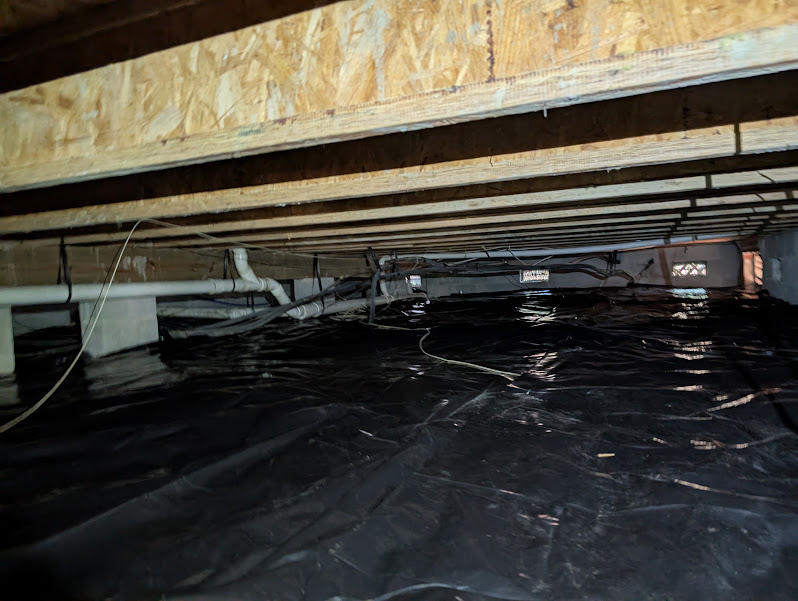
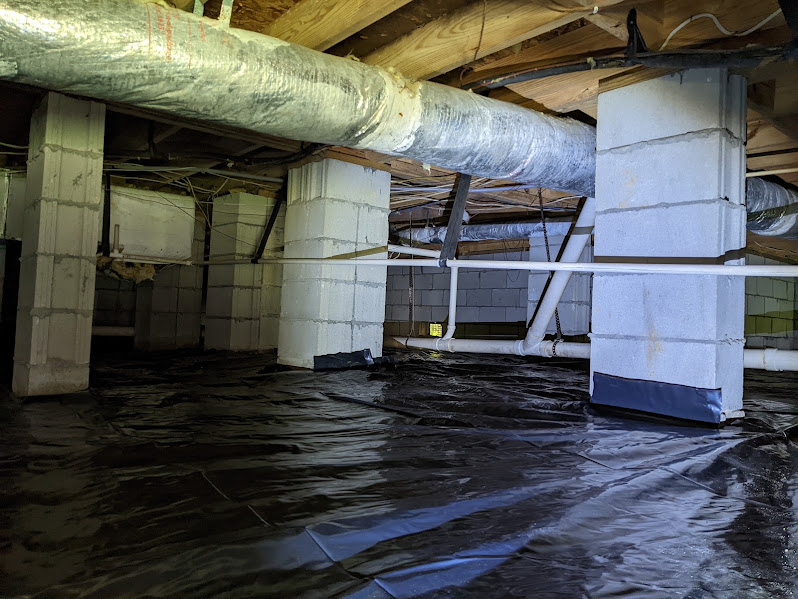
Reinforced material covers the ground, runs up the foundation walls, and wraps the piers. Seams are overlapped and sealed.
Vent and penetration sealing
Vents, access doors, and plumbing and wiring penetrations are sealed so humid outside air stops feeding the space.
Humidity control
A sealed crawlspace needs its air managed. We size a dehumidifier to the space and set the drainage before the liner goes in.
Moisture readings before and after
Wood moisture content and relative humidity are logged at the start and at completion, and both numbers go to you in writing.
Full photo documentation
Labeled photos of prep, liner, seams, vents, and equipment. Keep them for your records or hand them to an agent or attorney.
Why encapsulation comes up so often in the Lowcountry
Charleston homes were built with vented crawlspaces on the assumption that outside air dries the space. Here it does the opposite. Summer dew points sit in the 70s for months, so every vent pulls warm, wet air into a cool crawlspace where it condenses on joists, ducts, and pipes.
The water table adds to it. Across James Island, Johns Island, West Ashley, and much of Mount Pleasant, the soil under a crawlspace stays damp nearly year-round. Bare ground releases that moisture upward continuously, and wood-destroying fungi only need damp wood and time.
Because air moves upward through a house, crawlspace air becomes indoor air. That is why a wet crawlspace shows up as musty rooms, cupped hardwood floors, sticking doors, and an HVAC system working harder than it should. Sealing and controlling the space addresses the source instead of chasing the symptoms.
How an encapsulation runs
- 01
Free inspection
We crawl the full space, log moisture and humidity readings, and photograph the ground, framing, vents, and ductwork.
- 02
Straight recommendation
You get the photos and the readings, plus which option the space actually needs. Sometimes that is a vapor barrier, not encapsulation.
- 03
Cleanout and prep
Debris and failed insulation are removed, the soil is graded, and any standing water source is addressed first.
- 04
Liner, sealing, and equipment
Ground and walls are lined and sealed, vents and penetrations are closed, and humidity control is installed and drained.
- 05
Verify and review
We recheck moisture and humidity, walk you through the photo set, and explain what to watch going forward.
What it costs
[PRICING: Charleston encapsulations typically range $X-$Y depending on square footage, sealing scope, and dehumidification] We measure during the inspection and give you one flat price in writing. If a vapor barrier would solve your problem for a fraction of that, we will show you the readings that say so.
Encapsulation vs. vapor barrier: what Charleston homes actually need
A vented crawlspace is open to outside air by design. A sealed crawlspace is closed off from it and has its humidity managed mechanically. Those are two different systems, and the price difference is large, so the honest question is which one your house needs. Not which one sells better.
A vapor barrier covers the ground and cuts off soil moisture. That is the single largest moisture source in most crawlspaces. When a home has a dry footprint, decent drainage, no standing water, and the only real problem is bare soil giving up moisture, a properly installed and sealed barrier often brings the space into a healthy range on its own. It costs a fraction of an encapsulation and it solves the actual problem.
Full encapsulation earns its cost when the space is fighting more than the ground. Persistent humidity above 60 percent after the ground is covered, condensation on ducts and pipes, existing fungal growth on the framing, insulation that keeps failing, ductwork or mechanical equipment in the crawlspace, or a home where indoor comfort and energy use are clearly being dragged down by what is underneath. In those cases sealing the space and controlling its air is the only thing that holds.
Our inspection tells us which one you are looking at, because we measure instead of guessing. We log wood moisture content and relative humidity, photograph every area, and look for the source. If the readings do not support encapsulation, you will not get an encapsulation quote from us. If your crawlspace needs nothing at all right now, we will tell you that too, and the inspection is still free.
Frequently Asked Questions
Related work
Vapor Barrier Installation
The lower cost option when bare ground is the whole problem.
Crawl Space Dehumidifiers
Humidity control sized for a sealed Charleston crawlspace.
Crawlspace Cleanouts
Clear the space first so liner and seals hold properly.
Not sure which of these your home needs? Compare every option on our Charleston crawlspace services page, or read how we handle CL-100 moisture corrections before a closing.
Find out whether you need encapsulation before you pay for it.
Free crawlspace inspection across Charleston and the Lowcountry, with moisture readings and labeled photos you keep.